

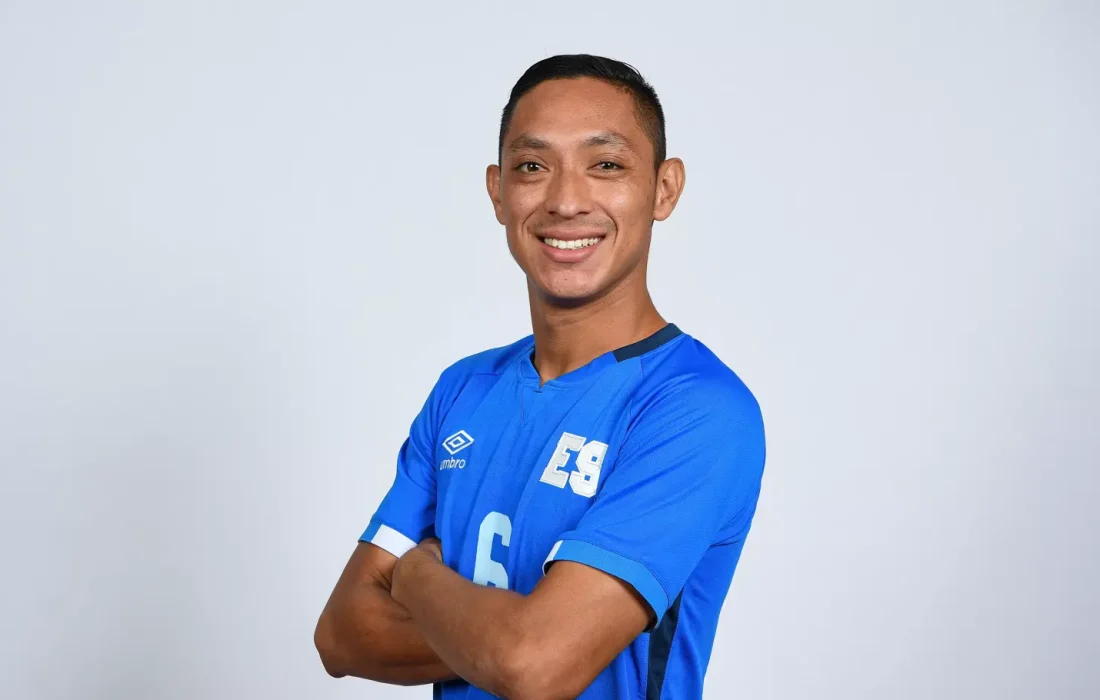
If there is one lesson that can be taken from fishing, it is patience. A line can be cast tens if not a hundred times before there is a bite. If you are willing to wait long enough, you can land the big fish.
It is fitting, then, that fishing is such a big part in the life of Jason Urbina. The 29-year-old rises every morning at 6am as a part-time fisherman at a nearby lake in El Salvador, before turning his attention to beach soccer coaching and training in the afternoons and evenings.
Hailing from a rural part of the Central American nation, Urbina did not have much in the way of beach soccer resources at his disposal growing up. However, true to his meticulous and imperturbable nature – traits found in the savviest of anglers – he became one of his country’s best forwards and earned a spot on the roster for the FIFA Beach Soccer World Cup Russia 2021™.
Now Urbina, who finished as the 2023 Concacaf Beach Soccer Championship’s top scorer, will set aside his rod and bait and try to fire El Salvador to a top-two finish at this year’s edition and, consequently, a place at Seychelles 2025.
What do you remember from the 2011 World Cup when El Salvador reached the semi-finals?
Jason Urbina: I was just a boy back then. I watched all of the games on my cellular phone. When they beat Italy [in the quarter-finals], it was such great joy. I was perhaps one of the biggest fans that the national team had. Ever since then, I’ve wanted to excel as a person and then as a sportsman so that the guys who qualified for the semi-finals in that World Cup would become my team-mates. They put me on the right path to be able to reach the national team and play in a World Cup. I think maybe as a fan it was the most spectacular moment I’ve lived.
El Salvador were in a tough group with Belarus, Brazil and Switzerland in 2021. While you didn’t win any matches, they were all very close. What did you think of El Salvador’s performance in that tournament?
We were training when we got the news about Brazil, Belarus and Switzerland in our group. We took it as motivation since we knew how strong those teams were. There were small details in our play that fell away from us, but the sensations were always good since it was a national team with so many young players. Now we are more experienced. But it was a World Cup in which we were taught a lot, we learned a lot about what’s to come in the future. Most of all, we enjoyed it. To have those great players and great teams there, you get to learn from them.
Unfortunately you had your attempt saved in the penalty-shootout defeat to Belarus in the opening match. What did you learn from that?
It was a difficult chapter for me, mainly because I was one of the regular penalty-takers for the national team. The nerves attacked me in that moment. When I missed, my team-mates and the coaching staff consoled me and supported me. Even when I returned to El Salvador, people didn’t look badly upon me. They knew that it was my first time, and for a person to make a World Cup from such a marginal place is a great achievement. I set my mind on improving many things: my finishing, penalties, free-kicks. I started to come out of that depression I was feeling about having failed not just myself, but my team and an entire country. Now it’s in the past and it has helped me grow both as a footballer and a person.
Can you describe the experience of hearing your national anthem in a World Cup and playing in a World Cup?
It was always my dream to represent my country in domestic tournaments, international tournaments and the biggest one of them all, the World Cup. When we qualified, tears came down my face because representing my country was the dream I had since I was a boy. When I arrived to Russia, it was a joyful feeling, I knew that I had achieved my main goal. In that first game, hearing the anthem, I got such big goosebumps and my eyes filled with tears that not only was my family supporting me, but also a community and entire country. It’s an unexplainable feeling.
The Concacaf Beach Soccer Championship is in March and most likely the second-place team in Group A will have to face USA in the semi-finals, so how important is it to win your group?
I think we ended up possibly in the group of death. We all have the same intentions of wanting to reach the semi-finals and fight for a [World Cup] ticket. We know how important it is to finish first, without underestimating any team, to then face a second-place team. All of us here are analysing all of the different possibilities, from the group stage to the semi-finals and final. We all want that World Cup ticket because it’s been four years since Russia. The expectations and motivation are very high.
Mexico are one of the toughest teams in your group. What are your thoughts on them?
We have a lot of respect for Mexico. We know the quality of their players, their head coach, they study us a lot and we study them as well. It is going to be a wonderful game because the big teams in Concacaf are Mexico, USA and ourselves. I think the match will come down to which team finishes their chances and stays the most organised.
If El Salvador qualify for the World Cup, how far can you all go at Seychelles 2025?
The expectations are very high. We want to feel the sensation of reaching the knockout rounds. Like everyone else, we want to be in the final but we know that there are tough opponents like Brazil, Portugal, Belarus. Depending on how things go, we are going to go step by step, try to get past each phase and go as far as possible.
Do you have another job?
When I am not with the national team, I do fishing. I also help children develop in beach soccer. I coach young boys and girls in the area where I live. It is a whole base of children to promote them to different teams and in different places so they can travel through El Salvador and then hopefully do what I did and get to the national team.
What is a typical day like in the life of Jason Urbina?
I get up at 6am to go fishing at a lake until 10am, more or less. I return to my house and rest for an hour. Later I spend time with my daughter, my family, and in the afternoon, from 2:30 to 4:30, I am coaching the youth teams of our club [CD Apulo Ilopongo]. Then from 5pm to 7pm, I’ll train and do all the work I need to do for the national team.
When I started in beach soccer it was really tough for me because there was no stadium, I had no place to train and there were no coaches. I watched videos on YouTube of European and Brazilian teams training and followed what they did. Later they built a stadium in my town and I got involved in it until I got a call to play in the Costa Rican league, and then the next year on the El Salvador national team.
What is your ideal beach soccer team?
My ideal team is Eliot [Mounoud] in goal, then Ozu, Be Martins, Leo Martins and Chiky Ardil. And my biggest idol is Leo Martins.