

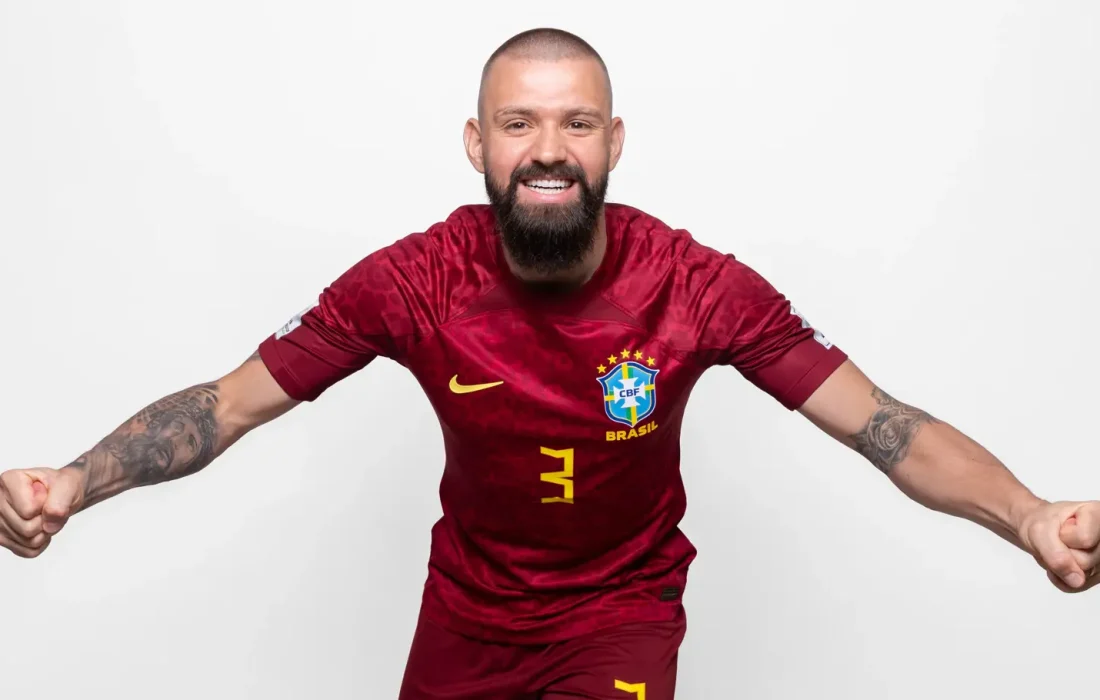
In a rare moment of free time to pause, breathe and spend time with family, Willian decided to head down from the mountains of Teresopolis to Rio de Janeiro. But there was a warning: “Don’t even think about Christ the Redeemer or anything like that – we’re off to the beach”, said the Brazil goalkeeper, laughing.
In Santa Catarina, Willian grew up with three passions: the girlfriend who ended up becoming his wife, futsal and surfing.
He first came into contact with futsal when he was six, at a small school in Jaragua do Sul, one of the country’s hubs for the sport. And his passion never ended. As a teenager, he was already earning money as a player, and as a 29-year-old he’s just been crowned the planet’s Best Men’s Goalkeeper for the first time.
Reaching the top wasn’t easy. It was stressful, required a lot of effort. The Santa Catarina native found surfing his way to handle it.
When deciding to accept an offer to play in Russia for MFK Norilsk Nickel, ending a fruitful 10-year stint with Joinville, Willian had many things to consider about the many adjustments he’d have to make. “Gaining international experience” and “taking a risk just before the World Cup” were at the forefront of his mind. But on a personal note, he would have to endure six months without being able to catch a wave.
And logically, that isn’t going to happen in Uzbekistan either! Here, he is focused on turning the Brazilian goal into a fortress in order to realise a dream shared with a group of veterans who have known each other for years and understand that this is a now or never.
In an ideal scenario, Willian would return to his country with the FIFA Futsal World Cup™ trophy and, why not, visit any accessible coastal destination to reconnect with the sea. First, however, he must face Costa on the court in the last 16 on Tuesday.
How do you feel right now, after Brazil’s excellent performances in the group stage?
Willian: It’s my second World Cup, and many here were also in Lithuania. In that World Cup, I knew the players, but I didn’t have much contact with them prior to the tournament. I was called up very close to the World Cup. It was different this time around. There is a feeling that the squad is very, very united and there are many friendships here that stretch back a long time. It’s been nice. Of course there is a lot of pressure in representing Brazil, but we prepared well for this and I think it’s part of, let’s say, carrying that burden. You have to know how to deal with it.
The building of the team starts with the goalkeeper, and Brazil have brought three great ones to the World Cup. How is the relationship between the three of you?
Brazil have always been very well served by its goalkeepers. All three of us have had very successful careers. I am the youngest of the three. I’ve only gotten to know Roncaglio more recently, even though he’s from near my city. I have watched him play ever since he was young. Guitta is an idol in Brazil. Having this kind of friendship with him, sharing ideas and experiences, is very cool. Our relationship is the best you could have, one of utmost respect. That’s the foundation for success, right? We are here with the goal of becoming world champions. We are fighting for the dream of our team-mates, so we need to have a strong commitment to the squad.
Guitta won the World Cup in 2012 and has immense respect in the futsal world. How important is he in the squad?
He has a lot of experience. He started very early in the national team and has always been part of very good teams, first in Brazil and then abroad. He’s had a very successful career that continues to this day. Today I play against him in Russia, I see that up close. Now I have this great happiness being able to work with him at such an important moment in my career. We have been talking a lot since the World Cup began.
Roncaglio paid a massive fee out of his own pocket to terminate his Anderlecht contract and be here. What did you think of that?
What he did was spectacular. We couldn’t really understand the club’s motivation. He did something huge, showing what desire he had to be here with us. This only increases the responsibility on us. I will fight as hard as I can for his dream of becoming a world champion.
What was it like to be voted the best in the world in your position? How did you receive the news?
On the day of the announcement, I was resting. When I woke up, I had a bunch of messages on my phone. I thought it was weird, as we are in a different timezone. But I saw that I had won. I called my wife, as it’s a dream we share as a family. Everyone was thrilled. Afterwards, I was also very happy to receive congratulations from some great goalkeepers, such as Gustavo, who played for Russia and who I worked with last season. He sent me a message saying ‘Welcome to the list’. It’s so cool to be on there with all those great names.
You received the award thanks to your final year playing for Joinville. When you decided to play in Russia, were there any preparations you needed to make for such a big change in a World Cup year?
I have always wanted the opportunity to play abroad and, at the same time, gain more experience. I couldn’t put it off any longer, and I needed to take that step. With the World Cup in mind, I wanted to play against great players and to see other styles of play for myself. It was a well-thought-out decision. I had a wonderful time in Joinville, but it was time to make the break and take that risk. But we didn’t have a great season in Russia. We didn’t get to the finals, I was injured and I found it difficult to adapt. I became anxious, but in the end it came good. The trust placed in me by Fred has also been crucial. I’ve been working with him for a long time, ever since I arrived at Joinville, at 18 years old. So I said that, as far as I could, I would do whatever was needed. I gave up my holiday time. I took advantage of Wilson Junior’s physiotherapy set-up in Jaragua do Sul, which is one of the best in Brazil, and I dedicated myself to working with Fred there.You have relatives involved in futsal, including Leo, your cousin, who is here at the World Cup with Kazakhstan. Have you had time to talk to him?
I started playing futsal because of an uncle of mine, who is Leo Jaragua’s father. I also have another professional cousin, Daniel Rosa, his brother. I started when I was about six years old. But Jaragua do Sul has always had a very strong team and a very strong youth team, so by the time I was 14 I was already playing more. It had a good structure, I started getting paid and I understood that it could be a profession. But even though they were my first cousins, we were distant. He was older and left Brazil very early to go to Kazakhstan, when I was finishing with my youth team. But we ended up playing together at Joinville and we developed a much closer relationship. It’s a different feeling, it’s like family. We always talk on video calls. He has two kids, I have one son. The children play together, we create a bond. He even gets a little mad at me because his son wants to be a goalkeeper (laughs). He says, ‘It’s a joke! It’s just because he likes you’. I’m rooting for him a lot. He got injured on the eve of the last World Cup. It was very sad, but now he’s making his dream come true.
We know how much you like to surf. How important is this second sport in your life?
I’ve always liked skateboarding, BMX and all kinds of extreme sports. It’s always been more my vibe, my type of people, let’s say. I discovered surfing through my father-in-law, who is from Balneario Camboriu. My wife and I started dating at a very young age, and we would head straight to the beach. He taught me how to surf. Living in Jaragua do Sul and Joinville, it’s very close. I really liked it. So I can tell you now that those six months I spent outside Brazil were very difficult. It wasn’t possible in Russia and surfing had been a big thing in my life. On a weekend, or sometimes during a midweek break, I would surf at the beach. It’s always helped me a lot, if I’m going through a stressful time or something. People who surf know what I’m talking about. It’s a really good feeling. Of course, as a high-performance athlete, we always want to improve our technique a bit. But you have to be careful (laughs). I’ve never stopped practicing.
Who knows, if you win the World Cup, there might be some time left for you to go back to Brazil to head to the sea?
Maybe there will be some kind of celebration, I don’t know. If we go back to Brazil, I would take advantage of that for a few days before going back to Russia, right? I remember that during our preparation in Teresopolis, we had a day off, and I was able to stay with my family in Rio de Janeiro. I said to my wife, ‘Let’s go to the beach! Don’t even think about Christ the Redeemer, nothing like that (laughs). Let’s go to a hotel by the beach and stay there all day long’. I needed it. The hardest part was watching people surf right in front of me. I joked that I would rent a surfboard (laughs). But I held myself back. God willing, we’ll go back and enjoy a short break. It would be great.